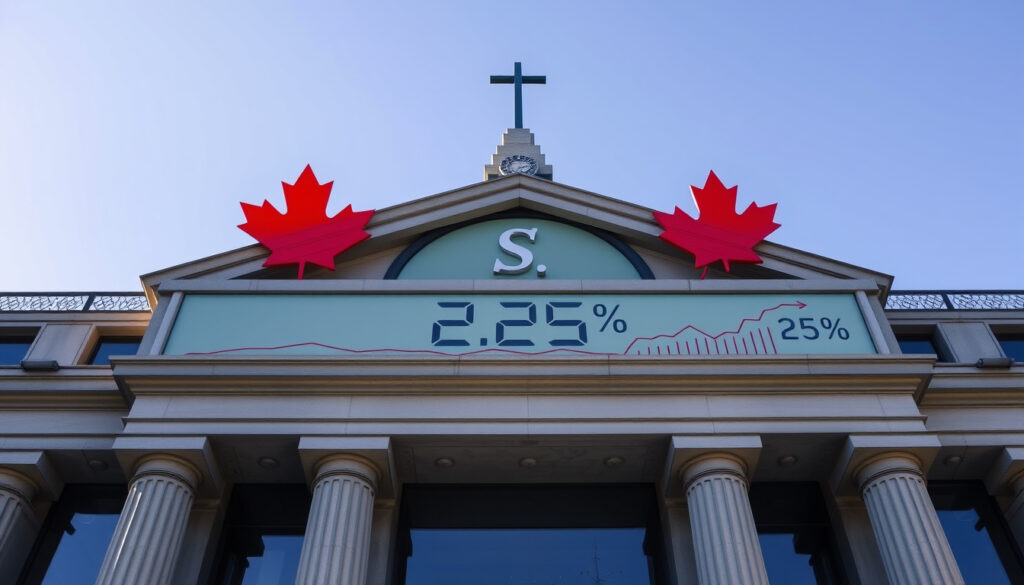
Bank of Canada Interest Rate Announcement – Rate Steady at 2.25%
The Bank of Canada held its overnight policy rate steady at 2.25% during its March 18, 2026 announcement, marking the fifth consecutive meeting without a rate change. The decision came as economic growth slowed and geopolitical tensions in the Middle East introduced renewed uncertainty into global energy markets.
Governor Tiff Macklem and the Governing Council indicated that while current monetary policy remains appropriate, they continue to monitor inflation closely. The Bank’s dual mandate requires balancing price stability with sustainable economic growth, a task made more complex by external shocks beyond Canada’s borders.
For Canadians carrying variable-rate mortgages or considering major financial decisions, the announcement provides important signals about borrowing costs in the months ahead. Understanding the Bank’s rationale and the economic indicators driving its decisions can help households plan more effectively.
What Was the Latest Bank of Canada Interest Rate Decision?
The Bank’s March 2026 decision reflected careful assessment of competing pressures. While inflation has moderated from its peak, the renewed geopolitical situation has created volatility in energy markets that could feed through to consumer prices.
Key takeaways from the announcement include:
- The overnight policy rate remains at 2.25%, steady since October 2025
- Economic growth has slowed more than anticipated in January forecasts
- Middle East tensions pose upside risks to inflation through energy channels
- The Bank will “look through” immediate energy price impacts but monitor for persistence
- Growth risks are described as “tilted to the downside”
- Excess supply in the economy continues to help contain inflationary pressures
| Indicator | Details |
|---|---|
| Target Rate | 2.25% (overnight policy rate) |
| Inflation Target | 2% (midpoint of 1-3% band) |
| Meeting Frequency | Eight times per year |
| Last Change | October 9, 2025 (-0.25%) |
| Recent Trend | Measured easing since early 2025 |
| Economic Growth | Below January forecast |
| Key Risk Factor | Geopolitical disruptions, energy prices |
| Mortgage Linkage | Prime rate tied to overnight rate |
When Is the Next Bank of Canada Interest Rate Announcement?
The Bank of Canada releases its interest rate decisions eight times annually, with four of those announcements accompanied by the comprehensive Monetary Policy Report. This schedule provides regular touchpoints for markets and households to assess the direction of monetary policy. Canadians can access official releases and supporting documentation directly through the Bank of Canada website.
Upcoming 2026 Announcement Dates
The next scheduled announcement falls on April 29, 2026. Following that date, investors and borrowers should mark their calendars for the remaining meetings scheduled throughout the year.
- April 29, 2026 — Next decision
- June 10, 2026
- July 15, 2026
- September 2, 2026
- October 28, 2026
- December 9, 2026
Announcements typically occur at 9:45 a.m. Eastern Time, with the press release published simultaneously on the Bank’s official website. The Governing Council’s statement and accompanying documents provide detailed rationale for each decision.
What to Watch Between Announcements
Between scheduled meetings, Canadians can track several key indicators that the Bank monitors when formulating policy. These include monthly inflation readings, employment statistics from Statistics Canada, and GDP growth figures. Changes in global energy prices and geopolitical developments also factor into the Bank’s ongoing assessment.
Bank of Canada interest rate announcements are released at 9:45 a.m. ET on scheduled dates. Press releases, statements, and supporting materials become available through the Bank’s official channels at that time.
How Does the BoC Interest Rate Announcement Affect Canadians?
Changes to the Bank of Canada’s policy rate have direct consequences for Canadian households, particularly those with variable-rate debt or those considering major purchases. Understanding these transmission mechanisms helps Canadians make more informed financial decisions.
Impact on Mortgage Rates
The prime rate that major Canadian banks use for variable-rate mortgages is tied directly to the overnight policy rate. When the Bank adjusts its rate, financial institutions typically pass those changes through to their mortgage products. This means variable-rate borrowers see immediate adjustments to their payments and borrowing costs.
For homeowners with variable-rate mortgages, the steady rate environment since October 2025 has provided predictability in monthly payments. However, those with fixed-rate mortgages tied to bond markets may have experienced different dynamics influenced by broader market expectations. The Financial Consumer Agency of Canada offers resources for understanding how these changes affect personal finances.
Variable-rate mortgage holders are most directly affected by Bank of Canada rate decisions. If you hold a variable-rate product, your prime rate and monthly payments adjust when the Bank changes its policy rate.
Broader Economic Effects
The Bank adjusts rates to maintain its 2% inflation target. When inflation runs above target, the Bank raises rates to reduce spending and cool the economy. When growth weakens and inflation falls below target, the Bank lowers rates to encourage borrowing, investment, and spending.
The current 2.25% rate reflects an economy where excess supply persists, meaning there is more capacity than demand. This environment has helped bring inflation down from its peak, but slower growth has created its own challenges for businesses and workers.
The Bank has flagged heightened uncertainty stemming from Middle East tensions. Energy price disruptions could complicate the inflation outlook, potentially affecting future rate decisions in ways that remain difficult to predict.
Beyond mortgages, interest rate decisions influence the cost of borrowing for businesses, affecting investment decisions and hiring. Consumer spending power, housing market activity, and the Canadian dollar’s value all respond to changes in monetary policy, creating ripple effects throughout the economy.
Bank of Canada Interest Rate History and Timeline
The Bank has implemented a measured easing cycle over the past year, reducing rates incrementally as inflation moderated. This followed an aggressive tightening campaign that brought rates from near zero during the pandemic era to a peak of 5% in July 2023.
Recent Rate Decisions
| Date | Policy Rate | Change |
|---|---|---|
| March 18, 2026 | 2.25% | No change |
| January 28, 2026 | 2.25% | No change |
| December 10, 2025 | 2.25% | No change |
| October 9, 2025 | 2.25% | -0.25% |
| September 17, 2025 | 2.50% | -0.25% |
| March 12, 2025 | 2.75% | -0.25% |
The pace of rate cuts has slowed considerably since the initial reductions in early 2025. The Bank has adopted a cautious approach, preferring to assess incoming data before moving rates further. This measured stance reflects uncertainty about the durability of inflation’s decline and the potential for external shocks to reverse progress.
Historical Context
The current rate of 2.25% sits near the midpoint of the Bank’s typical neutral range, where policy neither stimulates nor restrains economic activity. This positioning suggests the Bank sees the current stance as broadly appropriate for achieving its inflation target while supporting growth.
Why Did the Bank of Canada Make This Rate Decision?
The March 2026 decision reflects the Bank’s assessment of multiple competing factors. Economic growth has slowed beyond what was forecast in January, which would typically warrant lower rates. However, geopolitical developments have introduced new uncertainties that complicate the inflation outlook.
Geopolitical Factors
The conflict in the Middle East has created volatility in global energy markets, with oil prices experiencing fluctuations that could translate into higher costs for Canadian consumers and businesses. The Bank has indicated it will monitor whether these price increases remain temporary or become embedded in broader inflation expectations. For a deeper dive into the economic landscape, explore the ${economia italiana prospettive}. economia italiana prospettive
According to the Bank’s statement, policymakers will “look through” the immediate impact on inflation while remaining prepared to act if energy price shocks show signs of becoming persistent. This language suggests the Bank is distinguishing between volatile, temporary movements and more damaging sustained inflation.
Economic Fundamentals
Domestically, the economic picture presents mixed signals. Slower growth has helped contain inflation by maintaining excess supply in the economy, but it also raises concerns about employment and business investment. The Bank’s description of growth risks as “tilted to the downside” indicates greater concern about economic weakness than about overheating.
Inflation itself has moderated considerably from its 2022 peak, but the Bank continues to watch core inflation measures and inflation expectations to ensure the decline is sustained. Removing monetary policy accommodation too quickly risks reaccelerating inflation; waiting too long could unnecessarily constrain an already slowing economy.
Bank of Canada Interest Rate Decision: Timeline of Recent Events
- — Rate reduced by 0.25% to 2.75%
- — Rate reduced by 0.25% to 2.50%
- — Rate reduced by 0.25% to 2.25%
- — Rate held steady at 2.25%
- — Rate held steady at 2.25%
- — Rate held steady at 2.25%
The easing cycle that began in early 2025 has decelerated noticeably, with the most recent four meetings resulting in no changes. This pause reflects the Bank’s preference for data-dependent decision-making in an environment where the outlook remains unusually uncertain.
What We Know and What Remains Uncertain
| Established Information | Uncertain Factors |
|---|---|
| Current rate: 2.25% | Whether rates will decline further in 2026 |
| No change at March 2026 meeting | How long Middle East disruptions will persist |
| Growth below January forecast | Whether energy prices feed into core inflation |
| Rate steady since October 2025 | Timing of next rate adjustment |
| Eight announcements per year scheduled | Impact on employment and housing markets |
| Bank monitoring energy price shocks | Effect on inflation expectations going forward |
While the decision itself is confirmed and widely reported, the Bank has been candid about uncertainty regarding the economic outlook. External factors including geopolitical developments and their subsequent effects on energy prices remain difficult to predict with precision.
Understanding the Bank of Canada’s Policy Framework
The Bank of Canada operates under a mandate to keep inflation at 2% while supporting maximum sustainable employment. Unlike some central banks with a single mandate focused purely on price stability, the Bank must weigh both objectives when setting monetary policy.
The overnight policy rate serves as the primary tool for achieving these goals. By raising or lowering this rate, the Bank influences borrowing costs throughout the economy, which in turn affects spending, investment, and ultimately inflation. This transmission mechanism operates with lags, meaning policy changes take time to fully impact the economy.
The Governing Council, led by Governor Tiff Macklem, makes decisions collectively based on extensive analysis of economic data, financial conditions, and global developments. Transparency about the reasoning behind decisions is a key feature of modern central banking, helping markets and households anticipate future policy directions.
Sources and Key Perspectives
“The Governing Council will continue to carefully assess the economic implications of geopolitical developments, particularly their potential effects on energy prices and global inflation.”
— Bank of Canada, March 2026 Interest Rate Statement
Official sources for Bank of Canada announcements include the Bank’s own website and core publications detailing monetary policy frameworks. Financial institutions such as RBC provide consumer-focused explanations of how rate decisions translate into practical borrowing costs.
Economic analysis from institutions like TD Economics offers additional context for interpreting the Bank’s decisions, examining how various economic indicators factor into the Governing Council’s deliberations. Market participants also provide valuable perspective through reaction analysis following each announcement.
Summary and What to Watch
The Bank of Canada’s decision to hold rates steady at 2.25% reflects a cautious approach amid renewed uncertainty from global geopolitical developments. While domestic economic conditions continue to moderate inflation, external shocks have introduced risks that could complicate the path ahead.
For Canadians, the stable rate environment provides some predictability for planning, particularly for variable-rate mortgage holders. However, the Bank’s emphasis on monitoring energy prices and their potential to feed into broader inflation means future decisions remain genuinely uncertain. Those making significant financial commitments should factor this uncertainty into their planning.
The next announcement on April 29, 2026, will provide additional insight into how the Bank is weighing competing risks. Canadians can prepare by reviewing their mortgage structure and staying informed about economic developments that could influence future rate decisions. For related financial planning context, see our coverage of CRA 2026 Tax Season Changes.
Frequently Asked Questions
Will the Bank of Canada cut rates soon?
The Bank has held rates steady at 2.25% since October 2025 and shows no immediate signals of further cuts. The Governing Council is monitoring geopolitical developments and their potential impact on inflation before committing to additional easing.
What is the Bank of Canada interest rate forecast?
The Bank has not provided specific forward guidance on future rate movements. Market pricing suggests rates are expected to remain relatively stable, but the uncertainty introduced by Middle East tensions makes predictions particularly difficult.
What was the Bank of Canada interest rate decision today?
The Bank held its overnight policy rate steady at 2.25% on March 18, 2026. This marked the fourth consecutive meeting without a change, with the previous adjustment occurring on October 9, 2025.
How does the Bank of Canada interest rate affect mortgage rates?
Variable-rate mortgages are directly tied to the prime rate, which moves with the Bank’s policy rate. Fixed-rate mortgages tied to bond markets also respond to monetary policy changes and broader interest rate expectations.
When is the next Bank of Canada interest rate announcement?
The next scheduled announcement is April 29, 2026. The Bank announces decisions eight times annually, with announcements typically released at 9:45 a.m. Eastern Time.
What does the BoC interest rate announcement mean for me?
For borrowers, stable rates mean predictable payments on variable-rate products. For savers, the current environment offers limited returns on deposits. The decision affects everything from mortgage costs to business investment plans.
More related posts
 Dustin Hoffman 2025: Health, Career & Controversy Update
 CIBC Credit Card Login: How to Access Your Account Online
 Harry Potter à l’École des Sorciers: Age Guide & Quotes
 6 Tbsp to Cups – Exact US Conversion Guide
 The Hunger Game : Movie Order, Ban & Streaming Guide
 Cineplex VIP Cinemas Brentwood: Age, Parking, Menu & Reviews
 Tory Burch Canada Outlet: Locations, Online Sale & Discounts
 Ca t of Happy Gilmore (1996 & 2025): Full Li t of Actor & Cameo