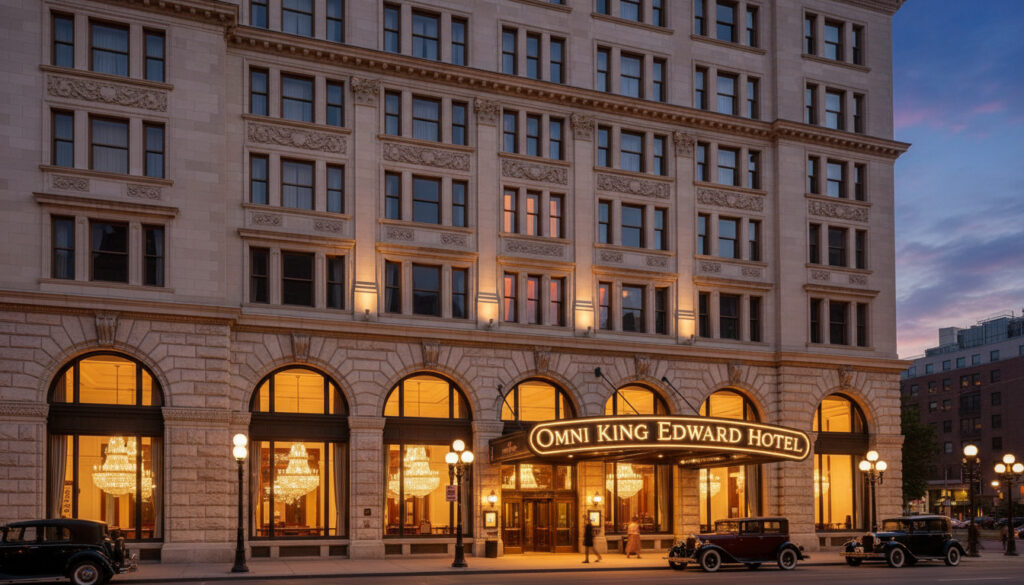
The Omni King Edward Hotel – History and Key Facts
Standing at the corner of King and Victoria Streets, the Toronto Omni King Edward Hotel has anchored the city’s hospitality scene since the Edwardian era. Known locally as the “King Eddy,” this limestone landmark at 37 King Street East opened in 1903 as the city’s first purpose-built luxury hotel, establishing a standard of opulence that would define Canadian hospitality for generations.
Designed by Toronto architect E.J. Lennox for developer George Gooderham’s Toronto Hotel Company, the property was named for King Edward VII and cost CA$2,000,000 to construct—approximately $71.9 million in today’s currency. What began as a 400-room fireproof palace has evolved through foreclosures, restorations, and rebranding to emerge as a 301-room member of Historic Hotels Worldwide, operated today by Omni Hotels since 2013.
The hotel’s footprint encompasses the entire city block bounded by King Street to the north, Victoria Street to the east, Colborne Street to the south, and Leader Lane to the west, placing it within walking distance of the Eaton Centre and Toronto’s theatre district.
What is the History of the Omni King Edward Hotel?
Location
37 King Street East
Downtown Toronto
Opened
1903
Architect
E.J. Lennox
(original building)
Current Chain
Omni Hotels
- Toronto’s first luxury hotel when it debuted in 1903
- Named after King Edward VII
- Original construction cost equivalent to $71.9 million in 2023 dollars
- Survived foreclosure during the Great Depression in 1933
- Underwent $30 million restoration between 1979 and 1981
- Inducted into Historic Hotels Worldwide in 2013
| Attribute | Detail |
|---|---|
| Original Opening | May 1903 |
| Original Room Count | 400 rooms, 300 baths |
| Construction Cost | CA$2,000,000 (1903) |
| Modern Equivalent | $71.9 million (2023) |
| Tower Addition | 1921-1922 |
| Tower Architect | Henry Ives Cobb |
| Tower Cost | CA$2,500,000 ($39.3M in 2023) |
| Peak Room Count | ~930 rooms |
| Current Room Count | 301 guest rooms and suites |
| Foreclosure | 1933 (Metropolitan Life Insurance) |
| Major Restoration | $30 million (1979-1981) |
| Historic Designation | Historic Hotels Worldwide (2013) |
Construction began in 1901 after demolition of the Walker Building, with E.J. Lennox designing a structure that claimed to be entirely fireproof—a significant selling point in an era of devastating urban fires. The hotel opened its doors in 1903, introducing Edwardian opulence to a city previously accustomed to Victorian restraint.
In 1921, the hotel expanded vertically with an 18-storey tower designed by Chicago architect Henry Ives Cobb, adding 530 rooms and replacing the adjacent Sullivan Hotel. This brought the room total to approximately 930, though the property now operates with 301 updated guest rooms and suites.
The property has changed hands numerous times throughout its history. Metropolitan Life Insurance foreclosed on the hotel in 1933, and ownership passed through various entities including C.A. Ripley and Vernon Cardy between 1941 and 1950. The hotel maintained a Sheraton affiliation until 1978, when Trans Nation, Inc. embarked on a $30 million restoration completed between 1979 and 1981. The property later operated as Le Royal Méridien King Edward (1994), then Le Méridien (2005), before Skyline Hotels & Resorts took management in 2012. Omni Hotels assumed operations in 2013, enrolling the property in Historic Hotels Worldwide.
Where is the Omni King Edward Hotel Located?
The Financial District Setting
The hotel sits at precise coordinates 43°38′58″N 79°22′36″W, nestled within Toronto’s financial district. Its position places guests within walking distance of the Eaton Centre shopping complex and the city’s theatre district, while St. Lawrence Hall—built following the 1849 Great Fire—stands nearby as a reminder of the area’s architectural resilience.
Architectural Context
The building showcases Edwardian Baroque style, featuring ornate moldings, 12-meter coffered ceilings, and floor-to-ceiling windows. The lobby displays unique oversized chess pieces, while the original main entrance once featured a glass-and-cast-iron canopy that welcomed guests arriving by carriage and early automobile.
The hotel occupies the full city block bounded by King Street to the north, Victoria Street to the east, Colborne Street to the south, and Leader Lane to the west. The main entrance faces King Street East.
Is the King Edward Hotel Haunted?
Separating Fact from Folklore
Despite persistent rumors regarding paranormal activity at the property, historical records remain silent on such claims. Despite the hotel’s age and dramatic history—including a 1933 foreclosure and multiple ownership changes—no archival documents or heritage registers reference supernatural occurrences.
The Historical Record
While the hotel has hosted figures whose lives generated myths and legends—Ernest Hemingway, Mark Twain, and various Hollywood stars—the property itself appears absent from the paranormal documentation that accompanies other historic Canadian hotels. The documented drama includes real-world events like celebrity proposals and political gatherings, rather than spectral apparitions.
Despite frequent online queries, no historical sources—including official heritage records, archival documents, or hospitality histories—reference haunting claims or ghost stories associated with this property.
What Amenities Does the Omni King Edward Hotel Offer?
Guest Accommodations
The property offers 301 spacious rooms and suites that blend turn-of-the-century architectural details with contemporary comforts. Rooms feature custom bedding, marble baths, and crown moldings that reference the building’s 1903 origins.
Ballroom and Event Spaces
The Crystal Ballroom underwent a $6.5 million upgrade that preserved its historic features while modernizing facilities. The Sovereign Ballroom retains original Edwardian Baroque architecture, including ornate moldings and period details. This space gained international attention in 1964 when Richard Burton proposed to Elizabeth Taylor there.
Current Services
Historical records do not document specific afternoon tea offerings or current room rates. As with most historic luxury properties, amenities and pricing fluctuate seasonally and are subject to operational changes under current management.
The Sovereign Ballroom features the same 12-meter coffered ceilings and Edwardian Baroque details that were present when Richard Burton proposed to Elizabeth Taylor there in 1964. Discover the Omni King Edward Hotel event spaces for current availability.
How Has the Omni King Edward Hotel Evolved Over Time?
- — Construction begins following Walker Building demolition — Wikipedia
- — Opens as Toronto’s first luxury hotel with 400 rooms and 300 baths — Historic Hotels of America
- — Henry Ives Cobb tower addition adds 530 rooms — Architectural records
- — Foreclosed by Metropolitan Life Insurance during the Great Depression — Heritage documentation
- — Ownership period under C.A. Ripley and Vernon Cardy — Omni Hotels history
- — End of Sheraton affiliation — Historic Hotels of America
- — $30 million restoration by Stanford Downey Architects — Wikipedia
- — Rebranded as Le Royal Méridien King Edward — Historic Hotels of America
- — Simplified to Le Méridien branding — Historic Hotels of America
- — Management transferred to Skyline Hotels & Resorts — Wikipedia
- — Joins Historic Hotels Worldwide under Omni Hotels operation — Historic Hotels of America
What Information is Verified About the Omni King Edward Hotel?
| Established Facts | Uncertain or Unavailable |
|---|---|
| Opened May 1903 as Toronto’s first luxury hotel | Official star rating not specified in available sources |
| Designed by E.J. Lennox; tower by Henry Ives Cobb | Current room rates fluctuate seasonally |
| Located at 37 King Street East | Afternoon tea service details unavailable |
| Hosted Elizabeth Taylor, The Beatles, Hemingway, Mark Twain | No historical documentation of hauntings |
| 301 current guest rooms and suites | Specific modern renovation costs post-2012 |
| Member of Historic Hotels Worldwide since 2013 | Original interior furnishings inventory |
Why Does the Omni King Edward Hotel Remain Significant?
The property marked a pivotal shift in Toronto’s urban development, transitioning the city’s hospitality scene from Victorian restraint to Edwardian opulence. As one of the first hotels to claim complete fireproof construction following devastating 19th-century fires, it exemplified modern engineering confidence. Its survival through the 1933 foreclosure and subsequent economic cycles demonstrates the enduring value of heritage hospitality infrastructure.
The hotel’s Edwardian Baroque architecture remains largely intact, offering a physical connection to Toronto’s emergence as a financial and cultural capital. By preserving original elements like the coffered ceilings while adapting to modern hospitality standards, the property serves as a case study in adaptive reuse of historic landmarks.
What Do Historical Records Say About the Hotel?
Construction began in 1901 after demolishing the Walker Building, costing CA$2,000,000 (equivalent to $71.9 million in 2023), and opened in 1903 as Toronto’s first luxury hotel with 400 rooms and 300 baths, claiming to be entirely fireproof.
— Wikipedia and Historic Hotels of America
An 18-storey tower designed by Chicago architect Henry Ives Cobb was added in 1921-1922 at a cost of CA$2,500,000 (equivalent to $39.3 million in 2023), adding 530 rooms and replacing the Sullivan Hotel.
— Historic Hotels of America
The hotel transitioned from Victorian restraint to Edwardian opulence, marking a shift in Toronto’s hotel scene after earlier venues like Montreal’s Windsor (1878).
— Heritage Toronto analysis
What Should Visitors Know About the Omni King Edward Hotel Today?
The Omni King Edward Hotel stands as Toronto’s oldest luxury hotel, bridging 1903 Edwardian elegance with contemporary hospitality. With 301 rooms, two historic ballrooms, and a location steps from the financial district, it offers documented historical significance—having hosted everyone from Mark Twain to The Beatles—rather than unverified ghost stories. Guests seeking a tangible connection to Toronto’s architectural heritage can explore its preserved Edwardian Baroque details while enjoying modern amenities.
Frequently Asked Questions
Who are some famous guests of the King Edward Hotel?
Notable visitors include Ernest Hemingway, The Beatles, Mark Twain, John Lennon, Elvis Presley, and Elizabeth Taylor, who received a marriage proposal from Richard Burton in the Sovereign Ballroom in 1964.
How much do rooms cost at the Omni King Edward Hotel?
Current room rates fluctuate seasonally and are not specified in available historical sources. Prospective guests should consult current booking platforms or the hotel directly for real-time pricing.
What is the afternoon tea experience at the King Edward Hotel?
Specific details regarding afternoon tea service are not documented in the historical records reviewed. The hotel may offer seasonal dining programs that vary throughout the year.
Is the King Edward Hotel said to be haunted?
Despite frequent online queries, no historical documentation, heritage records, or archival sources reference haunting claims or ghost stories associated with the property.
What is the star rating of the Omni King Edward Hotel?
Specific star ratings are not mentioned in available historical sources. The property operates as a luxury historic hotel under Omni Hotels management and is a member of Historic Hotels Worldwide.
When was the King Edward Hotel built?
Construction began in 1901, and the hotel opened in 1903. An 18-storey tower was added between 1921 and 1922.
More related posts
 Ash vs Evil Dead: Cancellation, Netflix Exit, and More
 Tickets 2021 Sites for Gamification Summit: Guide
 Avocat Droit de la Famille: Cost, Role & Free Options
 Marginal Tax Rate Ontario: 2026 Brackets & Calculator
 Sam O’Reilly: Biography, NHL Draft & Trade Myths
 All the Bright Places: Mental Health, Ending Guide
 Kitchener Airbnb Ceiling Collapse: Verified Update July 2025
 What Is the Smallest Country in the World? Vatican City