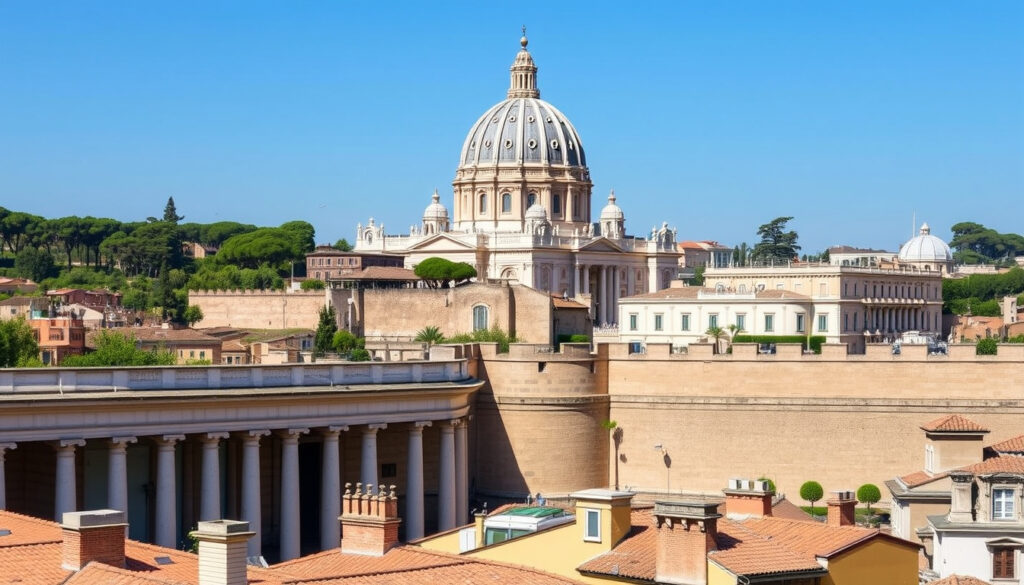
What Is the Smallest Country in the World? Vatican City
You’ve probably heard the answer: Vatican City, but the real story of the world’s smallest countries involves a tiny republic in the Pacific, a city famous for casinos, and a lot of confusion about what counts as a country. Vatican City, at just 0.44 square kilometers (0.17 square miles), is both the smallest by area and by population, with around 800 residents.
Smallest country by area: Vatican City · Area of Vatican City: 0.44 km² (0.17 sq mi) · Smallest country by population: Vatican City · Second smallest country by area: Monaco
Quick snapshot
- Vatican City – 0.44 km² (Britannica (authoritative encyclopedia))
- Monaco – 2.02 km² (Britannica (authoritative encyclopedia))
- Nauru – 21 km² (Britannica (authoritative encyclopedia))
- Tuvalu – 26 km² (Britannica (authoritative encyclopedia))
- Exact Vatican population fluctuates with temporary residents (InfoPlease (educational reference))
- Sealand is not recognized as a sovereign state by any UN member (Wikipedia (community-sourced encyclopedia))
- Exact area of Vatican City varies between 0.44 and 0.49 km² (World Population Review (demographics data aggregator))
- 1968 – Nauru gains independence, becomes the smallest republic (Swedish Nomad (travel and geography resource))
- Rising sea levels reportedly threaten Tuvalu’s existence as a sovereign state (YouTube educational content (tier3 source))
Six key facts cover the spectrum from the absolute smallest to the smallest in each continent.
| Fact | Value |
|---|---|
| Smallest country (area) | Vatican City (0.44 km²) |
| Smallest country (population) | Vatican City (~800) |
| Second smallest (area) | Monaco (2.02 km²) |
| Third smallest (area) | Nauru (21 km²) |
| Smallest in Africa | Seychelles (455 km²) |
| Smallest in Europe | Vatican City (0.44 km²) |
Vatican City is so small you could walk across it in 20 minutes. It holds the dual title of smallest by both area and population, a rarity among the world’s microstates.
What is the smallest country in the world?
The smallest country in the world is Vatican City, an independent city-state surrounded by Rome, Italy. It covers just 0.44 square kilometers (0.17 square miles) and has a population under 1,000 — many of whom live there only temporarily. A country so small that it has no permanent citizens; all residents are foreign-born, and citizenship is granted based on appointment or employment within the Holy See (InfoPlease (educational reference)).
Vatican City became a sovereign state in 1929 with the Lateran Treaty (Wikipedia (community-sourced encyclopedia)). It is the only country with a zero percent population growth rate and the lowest fertility rate globally (InfoPlease (educational reference)).
Vatican City: The Undisputed Smallest
- Area: 0.44 km² — roughly one-sixth the size of Central Park (Britannica (authoritative encyclopedia))
- Population: Approximately 506–825, including about 450 citizens (World Population Review (demographics data aggregator))
- Independence: 1929 via the Lateran Treaty (Wikipedia (community-sourced encyclopedia))
Debunking the ’24 People’ Myth
No UN-recognized country has a population of 24. The claim that there is a country with exactly 24 people is a myth often associated with Sealand or other micronations. Vatican City has the smallest official population, around 800. Sealand and other self-proclaimed entities lack sovereignty (Wikipedia (community-sourced encyclopedia)).
The implication: Vatican City is an outlier by every metric — a sovereign state that functions more like a heavily guarded compound, yet commands global diplomatic influence as the seat of the Catholic Church.
Which are the 10 smallest countries in the world?
All ten are UN member states, listed here by land area. The pattern shifts dramatically after the top four, as island nations start to appear.
- 1. Vatican City – 0.44 km²
- 2. Monaco – 2.02 km²
- 3. Nauru – 21 km²
- 4. Tuvalu – 26 km²
- 5. San Marino – 61 km²
- 6. Liechtenstein – 160 km²
- 7. Marshall Islands – 181 km²
- 8. Saint Kitts and Nevis – 261 km²
- 9. Maldives – 300 km²
- 10. Malta – 316 km²
Britannica (authoritative encyclopedia) provides this list for all ten. What stands out: Europe dominates the top five, while the Pacific claims Nauru, Tuvalu, and the Marshall Islands.
Monaco, Nauru, and Tuvalu: The Next Three
Monaco (2.02 km²) is not only the second smallest but also the most densely populated country, roughly the size of New York’s Central Park (Britannica (authoritative encyclopedia)). Nauru (21 km²) is the smallest republic and gained independence from Australia in 1968 (Swedish Nomad (travel and geography resource)). Tuvalu (26 km²) is a Polynesian island nation at risk from climate change.
The Remaining Six: San Marino, Liechtenstein, Marshall Islands, Saint Kitts and Nevis, Maldives, Malta
San Marino is an enclave within Italy with a population of about 34,000. Liechtenstein, the Marshall Islands, Saint Kitts and Nevis, the Maldives, and Malta round out the top ten. Each is a UN member and all are considered microstates — countries with land area under 1,000 km².
Why this matters: The top ten list corrects the common error of including dependencies like Greenland (which is not a country) or micronations like Sealand (not recognized). Only sovereign states with UN membership qualify.
Which country is the 2nd smallest in the world?
The second smallest country is Monaco, with an area of 2.02 km² (0.78 square miles). It is also the world’s most densely populated sovereign state, home to nearly 39,000 people (World Population Review (demographics data aggregator)).
Monaco: The Second Smallest by Area
- Area: 2.02 km² (Britannica (authoritative encyclopedia))
- Population: ~38,087–38,350 (World Population Review (demographics data aggregator))
- Density: Over 19,000 people per km²
Comparison of Monaco’s Size and Population
Monaco is 4.6 times larger than Vatican City by area, but its population is roughly 50 times larger. The contrast highlights how Vatican City’s population is artificially small — determined by job roles, not permanent settlement.
The catch: Monaco’s tiny size hasn’t stopped it from becoming a global finance and tourism hub. Its density is unmatched among sovereign states.
What is the fourth smallest country in the world?
The fourth smallest country is Tuvalu, with an area of 26 km² (10 square miles). It is located in the Pacific Ocean, about halfway between Hawaii and Australia (Britannica (authoritative encyclopedia)).
Tuvalu: The Fourth Smallest by Land Area
- Area: 26 km² (Britannica (authoritative encyclopedia))
- Population: ~9,362–11,300 (InfoPlease (educational reference))
- Independence: 1978 from the United Kingdom
Geographic and Cultural Highlights of Tuvalu
Tuvalu is made up of nine islands, none higher than 4.5 meters above sea level. Rising sea levels reportedly threaten its long-term existence (YouTube educational content (tier3 source)). Culturally, Tuvalu preserves strong Polynesian traditions and has one of the smallest economies in the world.
Tuvalu faces an existential risk from climate change. With its highest point just 4.5 meters, even moderate sea-level rise could make the country uninhabitable within decades. For Tuvaluans, the smallest countries bring the biggest consequences.
The pattern: Tuvalu’s vulnerability illustrates the existential threats facing microstates in the Pacific.
What is the smallest country in Africa?
The smallest country in Africa is Seychelles, an archipelago nation in the Indian Ocean with an area of 455 km² (176 square miles). It is also the least populous African country, with about 99,000 residents (Britannica (authoritative encyclopedia)).
Seychelles: The Smallest Country in Africa
- Area: 455 km² (Britannica (authoritative encyclopedia))
- Population: ~99,000 (World Population Review (demographics data aggregator))
- Independence: 1976 from the United Kingdom
Other Small African Nations (São Tomé and Príncipe, Mauritius)
The second smallest African country is São Tomé and Príncipe at 964 km², followed by Mauritius at 2,040 km². Both are island nations that gained independence in the 1960s–70s. African microstates are all island nations — the continent’s mainland smallest, The Gambia (11,300 km²), is much larger.
The pattern: African microstates cluster in the Indian and Atlantic Oceans, not on the continent itself. This reflects colonial histories that created small island sovereign states.
Five microstates, one pattern: the smallest countries share a common fate — tiny land areas but outsized diplomatic and environmental significance.
Here is a comparison of the top five smallest countries by area, population, and density.
| Country | Area (km²) | Population | Density (per km²) |
|---|---|---|---|
| Vatican City | 0.44 | ~800 | 1,818 |
| Monaco | 2.02 | ~38,350 | 18,985 |
| Nauru | 21 | ~12,100 | 576 |
| Tuvalu | 26 | ~11,300 | 435 |
| San Marino | 61 | ~34,000 | 557 |
Data sourced from Britannica (authoritative encyclopedia) for area and World Population Review (demographics data aggregator) for population. The takeaway: Vatican City and Monaco are density outliers, whereas Nauru and Tuvalu are sparsely populated by comparison.
What we know and what’s still unclear
Confirmed facts
- Vatican City is the smallest country by area and population (UN member status confirmed by Britannica (authoritative encyclopedia))
- Monaco is the second smallest by area (Britannica (authoritative encyclopedia))
- Nauru and Tuvalu are third and fourth by area (Britannica (authoritative encyclopedia))
What’s unclear
- Exact population of Vatican City fluctuates due to temporary residents (InfoPlease (educational reference))
- Sealand’s status as a country is not recognized by any UN member
- Exact area of Vatican City varies between 0.44 and 0.49 km² (World Population Review (demographics data aggregator))
“Vatican City holds the title as the world’s smallest country, with an area of just 0.17 square mile (0.44 square km).”
Britannica (authoritative encyclopedia)
“Vatican City is the world’s smallest country by land area, covering about 0.19 square miles (0.49 km²).”
World Population Review (demographics data aggregator)
For travelers hoping to visit every microstate, the challenge is real: three of the top five are islands in remote oceans, and Vatican City alone requires planning around a papal audience. The smallest countries may be tiny on a map, but their influence — diplomatic, environmental, cultural — is anything but.
Related reading: How Many People Died on the Titanic
Frequently asked questions
Is Vatican City a recognized independent country?
Yes. Vatican City is a sovereign city-state recognized by the United Nations as a non-member observer state. It gained independence in 1929 via the Lateran Treaty with Italy (Wikipedia (community-sourced encyclopedia)).
Why isn’t Sealand considered a country?
Sealand is a micronation — a self-proclaimed entity that meets none of the criteria for statehood under the Montevideo Convention. No UN member recognizes it as sovereign.
Which is the smallest country in Asia?
The Maldives, at 300 km², is the smallest Asian country by both area and population (Britannica (authoritative encyclopedia)).
What is the smallest country in South America?
Suriname (163,820 km²) is the smallest country in South America by area. There are no microstates in mainland South America.
How many microstates are there in the world?
There are 24 UN-recognized countries with land area under 1,000 km². They are commonly referred to as microstates.
Can you visit all the smallest countries?
Yes, but it requires significant travel. Three of the top five (Nauru, Tuvalu, and Vatican City) are accessible, while Monaco and San Marino are easy to reach from Europe.
What is the difference between a microstate and a micronation?
A microstate is a sovereign state recognized by the UN and other nations (e.g., Vatican City). A micronation is a self-declared entity lacking international recognition (e.g., Sealand, Freetown Christiania).
More related posts
 Where to Inject Ozempic – Abdomen, Thigh, Arm Guide
 UHN Portal Sign In Guide: myUHN MyChart Login Steps
 Symptoms of Kidney Disease – Early Signs and Stages
 Remote Jobs in Canada 2025: Guide to Visas, Hiring & Salaries
 Île-aux-Tourtes Bridge: Cost, Closures & 2025 Timeline
 Dave’s Hot Chicken Near Me – Find Locations, Hours and Menu
 National Bank of Canada Review: Is It Safe and a Good Bank?
 Canada Men’s National Soccer Team – Roster, Coach and 2026 Outlook