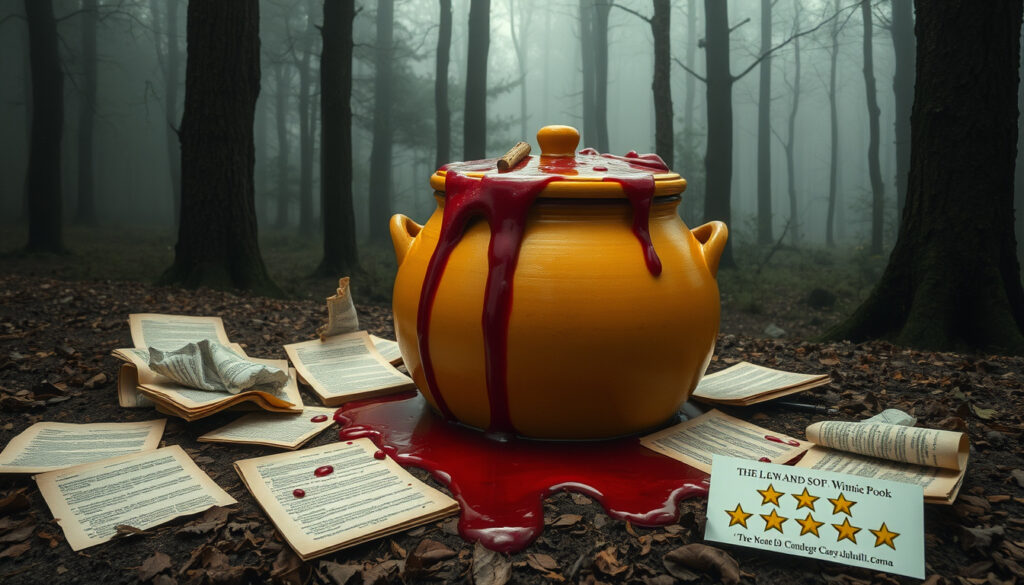
Winnie the Pooh Blood and Honey: Legal, Plot, Reviews
A slasher film that transforms a beloved teddy bear into a blood-soaked killer—Winnie-the-Pooh: Blood and Honey proves that public domain horror can be both legally viable and commercially successful. Director Rhys Frake-Waterfield exploited a narrow legal window when A.A. Milne’s original characters entered the public domain, creating a franchise that grossed $8 million against a $500,000 budget.
Release Year: 2023 ·
Director: Rhys Frake-Waterfield ·
Genre: Slasher Horror ·
Key Characters: Winnie-the-Pooh, Piglet ·
Plot Trigger: Christopher Robin leaves
Quick snapshot
- Original 1926 book entered public domain January 1, 2022 (Arizona State University Sandra Day O’Connor College of Law)
- Directed and produced by Rhys Frake-Waterfield (The Optionist)
- Blood and Honey 2 grossed $8 million against $500,000 budget (Wikipedia)
- Exact Rotten Tomatoes score for first film
- Streaming distribution agreements beyond theatrical
- Whether Disney has issued formal legal challenges
- Tigger enters public domain January 1, 2024 (ASU Law)
- Tigger’s Return spin-off announced January 2025 (Wikipedia)
- Blood and Honey 3 in active development ((ASU Law))
- Third film Blood and Honey 3 in development (Wikipedia)
- Tigger’s Return planned as TCU Phase 2 (Wikipedia)
- Sequel greenlit November 2022 (Wikipedia)
Production details
| Detail | Information |
|---|---|
| Director | Rhys Frake-Waterfield (The Optionist) |
| Producer | Rhys Frake-Waterfield |
| Year | 2023 |
| Country | United Kingdom |
| Production Company | Jagged Edge Productions (The Optionist) |
How is Winnie-the-Pooh: Blood and Honey legal?
The film walks a narrow legal corridor that Disney spent decades trying to close. A.A. Milne’s original Winnie-the-Pooh stories entered the public domain in the United States on January 1, 2022, after copyright protections that dated back nearly a century finally expired (Arizona State University Sandra Day O’Connor College of Law). This meant anyone could adapt, remake, or—in Frake-Waterfield’s case—horrify the characters without licensing payments to anyone.
Public domain entry in 2022
For works created before 1978, copyright protection generally lasts 95 years from first publication (The Optionist). The Copyright Term Extension Act of 1998—nicknamed “The Mickey Mouse Protection Act” based on Disney’s lobbying efforts—sealed the original Pooh’s fate by pushing the public domain date forward by 20 years (Romano Law). When that clock finally ran out in 2022, Milne’s bear and his Forest companions joined a growing roster of characters that studios had preferred to keep locked away.
Disney’s trademarks create a firewall that limits how far filmmakers can push public domain characters. The company still owns copyright to Winnie-the-Pooh elements created after 1926, including the iconic red shirt design and characterizations from Disney’s animated films (Romano Law). Anyone adapting the original book must avoid mimicking the studio’s distinctive visual language or face trademark infringement claims.
Disney trademarks vs story rights
The distinction between “story rights” and “trademark rights” is what makes films like Blood and Honey legally permissible but commercially risky. Blood and Honey draws inspiration only from the first 1926 book, deliberately excluding Tigger, who was introduced in 1928 and remained under copyright protection until January 1, 2024 (The Optionist). The filmmakers also cannot use Disney’s specific character designs, the character’s recognizable voice, or any visual elements tied to the studio’s trademarked interpretations.
Piglet and Eeyore entered the public domain on January 1, 2022, alongside the original Winnie-the-Pooh—but Kanga and Roo remain off-limits for filmmakers working strictly within public domain boundaries (Romano Law).
What happens to the Winnie the Pooh copyright?
The copyright question for Winnie-the-Pooh is essentially settled for the 1926 book, but the broader implications for other characters remain in flux. Tigger’s copyright protection lapsed on January 1, 2024, clearing the way for Tigger’s Return, the announced spin-off from producer Scott Chambers (Arizona State University Sandra Day O’Connor College of Law). This creates a template that other studios may follow as more classic characters shed their copyright protections over the next decade.
Original book enters public domain
The 1926 book includes Winnie-the-Pooh, Piglet, Eeyore, Owl, and Rabbit—all now free for creative adaptation outside Disney’s control. The Copyright Term Extension Act of 1998 protected works made for hire for 95 years from first publication or 120 years after creation, whichever came sooner (Romano Law). For post-1978 works, copyright lasts for the life of the author plus 70 years.
Later adaptations remain protected
Disney’s versions of the characters, including the animated films from the 1960s and 1970s, remain under copyright protection. The studio also maintains trademarks for its development and rendition of Winnie-the-Pooh, including the iconic red shirt version (Romano Law). This creates a two-tier system where the underlying literary works are free but their most popular modern interpretations remain controlled.
The Golan v. Holder Supreme Court decision in 2012 established that Congress may remove works from the public domain without violating the Constitution (ASU Law). Disney has previously lobbied for copyright extensions, and the success of Blood and Honey may provide renewed incentive for legislative action that could pull more characters back under protection.
Is Blood and Honey a good movie?
“Good” is a complicated question when it comes to slasher films, and Blood and Honey has divided audiences along predictable lines. The film earned a 47% rating on Rotten Tomatoes for its sequel, with critics noting that the acting and production values lag behind the ambition of the concept (Wikipedia). Audience reactions have been more forgiving, with viewers who embrace grindhouse aesthetics finding value in what the film attempts.
Critical reception
Blood and Honey 2 received a Metacritic score of 27 out of 100 based on nine critics, indicating “generally unfavorable” reviews (Wikipedia). Critics particularly noted weak acting performances and moments where the CGI effects strain credibility. However, the film’s low budget makes such criticism somewhat relative—a $500,000 production cannot compete technically with major studio releases, and some reviewers acknowledged that the film knows exactly what it is.
Audience reactions
Common Sense Media noted the film features “extremely violent and graphic gore” content, with parents and sensitive viewers given clear warning about the disconnect between the beloved source material and the on-screen violence (Common Sense Media). Reddit users who reviewed the film highlighted an “impressively high body count” and gore levels that exceeded expectations for a low-budget production.
Upsides
- Low production budget makes the risk minimal for producers
- High body count satisfies slasher fans seeking graphic content
- Public domain characters require no licensing fees
- Sequel grossed $8 million worldwide against $500,000 budget (Wikipedia)
Downsides
- Critics note poor acting and weak dialogue
- CGI effects draw negative comparisons to higher-budget productions
- Rotten Tomatoes score of 47% indicates mixed critical reception (Wikipedia)
- Disney trademark restrictions limit creative freedom
What was the point of Winnie-the-Pooh: Blood and Honey?
At its core, Blood and Honey is a story about abandonment and what happens when gentle creatures are pushed too far. The plot centers on Christopher Robin, who leaves the Hundred Acre Wood and returns years later to find that Pooh and Piglet have become violent, starving killers willing to kill for food. The thematic resonance with children’s characters turned monstrous gives the film more than cheap shock value—it taps into something unsettling about familiar images corrupted.
Plot summary
After Christopher Robin’s departure, Pooh and Piglet are left to survive in the Forest without his care. Hunger drives them to violence, and they begin a bloody rampage through their former home. The film plays on the contrast between the gentle, honey-loving bear of Milne’s original stories and the feral killer who emerges from prolonged abandonment. Friends become predators, and the Forest becomes a hunting ground.
Themes of abandonment
The horror in Blood and Honey emerges from a recognizable emotion—being left behind—taken to an extreme conclusion. Pooh’s transformation from companion to killer reflects the film’s central idea that love turned to resentment can curdle into something dangerous. This thematic layer elevates the film beyond pure exploitation, even if execution quality prevents it from becoming art.
The film uses horror conventions to explore themes of loss and isolation that resonate beyond the gimmick of beloved characters turned violent.
Is Piglet a sequel to Blood and Honey?
Piglet is not a direct sequel to Blood and Honey but exists within the same creative universe. Director Rhys Frake-Waterfield is building what he calls the Twisted Childhood Universe (TCU), a shared framework for horror adaptations of public domain children’s characters. Piglet connects to this universe rather than continuing Blood and Honey’s specific storyline.
Connection to Twisted Childhood Universe
Blood and Honey 2 is the second installment of the Twisted Childhood Universe, establishing a franchise framework that extends beyond individual films (Wikipedia). The TCU allows filmmakers to introduce characters from different public domain sources and connect them through shared horror aesthetics. This universe-building approach treats the franchise like a horror-themed shared universe rather than a simple series of sequels.
Separate but shared universe
While Piglet does not continue Blood and Honey’s plot directly, the film shares creative personnel and tonal ambitions with its predecessor. Director Frake-Waterfield expressed interest in expanding the universe following the first film’s success, leading to the sequel greenlight in November 2022 (Wikipedia). The shared universe model gives filmmakers flexibility to tell self-contained stories while building toward larger crossover narratives.
Timeline of events
Eight key moments trace the path from a 1926 children’s book to a multi-film horror franchise.
| Date | Event |
|---|---|
| January 1, 2022 | Winnie-the-Pooh book enters public domain in the United States |
| 2023 | Blood and Honey released in theaters |
| November 2022 | Blood and Honey 2 sequel greenlit |
| January 1, 2024 | Tigger enters public domain |
| March 18, 2024 | Blood and Honey 2 premieres in London |
| March 26, 2024 | Blood and Honey 2 released theatrically in the United States |
| 2025 | Blood and Honey 3 in active development |
| January 2025 | Tigger’s Return spin-off announced |
The timeline reveals a pattern of rapid franchise expansion driven by modest budgets and viral controversy. Each release has pushed further into public domain territory as new characters become available, with the producer Scott Chambers announcing in January 2025 that Tigger’s Return would launch the Twisted Childhood Universe’s second phase (Wikipedia).
Confirmed facts and unknowns
The franchise has generated both concrete facts and persistent gaps in verifiable information.
- Public domain status for 1926 book: Confirmed—A.A. Milne’s original entered public domain January 1, 2022 (ASU Law)
- Director Rhys Frake-Waterfield: Confirmed—also serves as producer on both films (The Optionist)
- 2023 release date: Confirmed—the first film released in 2023
- Blood and Honey 2 box office: Confirmed—$8 million gross against $500,000 budget (Wikipedia)
- Exact Rotten Tomatoes score for first film: Unclear—second film shows 47% rating (Wikipedia)
- Streaming deals like Netflix: Unclear—no verified streaming platform announcements for original film
- Eeyore death specifics: Unclear—confirmed as occurring in film but specific details not verified
What people are saying
Extremely violent and features graphic gore.
— Common Sense Media (Common Sense Media review)
Impressively high body count. Lots of gore.
— Reddit user review
The critical consensus around Blood and Honey acknowledges what the film is attempting rather than judging it against conventional quality standards. Common Sense Media’s assessment captures the essential tension—the source material’s gentle reputation makes the violence feel more transgressive than it might with original characters. Audience reviews on platforms like Reddit have been more positive, with viewers appreciating the film’s commitment to genre conventions despite its limited budget.
For horror fans, the franchise represents a template for low-budget exploitation that leverages cultural recognition without licensing costs. For studios like Disney, the films serve as an uncomfortable reminder that their trademark protections, while robust, cannot prevent all uses of characters they helped popularize. The commercial success of Blood and Honey ($8 million on $500,000) signals that public domain horror may become a more common genre as classic characters continue to enter open circulation.
Winnie the Pooh Blood and Honey’s legal reviews and sequels have fueled endless debates on public domain horror adaptations and their mixed reception.
Frequently asked questions
When was Winnie-the-Pooh: Blood and Honey released?
The first film was released in 2023, with the sequel Blood and Honey 2 premiering in London on March 18, 2024, and receiving U.S. theatrical release on March 26, 2024.
Who is in the cast of Winnie-the-Pooh: Blood and Honey?
The film was directed and produced by Rhys Frake-Waterfield of Jagged Edge Productions. Specific cast member details for the first film are limited in verified sources, but the sequel expanded the ensemble with additional performers to support the expanded storyline.
Is Winnie the Pooh: Blood and Honey on Netflix?
Streaming availability for the original film has not been confirmed in verified sources. The sequel received a theatrical release, and future streaming distribution plans remain unclear.
What is the plot of Winnie-the-Pooh: Blood and Honey?
When Christopher Robin leaves the Hundred Acre Wood, Pooh and Piglet are abandoned and left to survive without his care. Hunger transforms them into violent killers who begin a bloody rampage through the Forest. The film presents a horror twist on Milne’s original characters.
Why did Christopher Robin leave Pooh and Piglet?
The film implies Christopher Robin departs as part of his maturation into adulthood, leaving behind the characters and world of his childhood. The specific reasons for his departure are not fully explored in the film’s narrative.
What are the sequels to Winnie-the-Pooh: Blood and Honey?
Blood and Honey 2 was released in 2024, grossing $8 million against a $500,000 budget. Blood and Honey 3 is in active development. A spin-off film titled Tigger’s Return was announced in January 2025 as part of the Twisted Childhood Universe’s second phase.
Is Piglet male or female?
In A.A. Milne’s original stories, Piglet is male—a detail that some viewers find surprising given the character’s traditionally perceived gentle demeanor. Piglet entered the public domain along with the 1926 book and appears in the Blood and Honey films as a violent antagonist alongside Pooh.
More related posts
 Indeed Jobs Red Deer – 2,000+ Openings in Retail and Trades
 Jewelry Store Near Me: Best in Dublin Ireland & Tips
 180 Days in Months: Is It 6 Months or 5.92 Exactly?
 Sajal Malik Viral Video – Facts Timeline and Investigation
 How Many People Died on the Titanic – Casualty Breakdown
 Cast of the Shawshank Redemption – Actors, Roles and Trivia
 Saucony Endorphin Pro 4 – Specs Price and Performance Review